Do you know about PACING BOARDS? Pacing Boards are a MUST for any therapy room. I usually keep a stash of pacing boards, with varying shapes and colors in different length sets–stored in a pocket chart or hung from a magnetic clip so I can grab them quickly when I need them. They are easily accessed during a therapy session and are useful in almost any therapy activity. My gift to you on this Giving Tuesday is a holiday themed printable containing two pacing boards. Use these festive pacing boards to give students visual/tactile/kinesthetic input for reducing rate of speech, increasing fluency, sequencing sounds/syllables in multisyllabic words, increasing mean length of utterance, formulating sentences, marking grammatical structures in a sentence, increasing conversational reciprocity and more!! These pacing boards can be essential tools to increase student independence as they practice skills — perfect for students to use at home, too — just print onto cardstock or durable paper and/or laminate. You can print multiple sets and then cut the boards to include only two or three shapes — perfect for targeting formulation of two and three word utterances. These boards can also be used as game score cards, schedule cards, token reinforcement cards, pattern sets or sorting cards!! Hope you enjoy this freebie, and put it to good use…I’d love to hear how you use this resource, so leave a comment to let me know! Thanks for visiting LiveSpeakLove!
Here is a resource I have for you to help put you in the LiveSpeakLove holiday spirit! Target /s/ in all positions of words with this cute printable activity I created. Santa’s hat contains practice words with /s/ in the initial position of CV and CVCV words. His beard contains /s/ in the initial, medial and final positions of one and two syllable words. This worksheet is perfect for speech therapy homework, practice folders, data collection probes, RTI and more.
Very excited to be moving into the festive holiday season…ready to decorate the LiveSpeakLove headquarters with my little (and not so little) ones! I love how memories flow as we unpack beloved ornaments, and blend them with new traditions. Wishing you all a wonderful start to your holiday season, and hope that you will enjoy some activities I have for you:
Target word class skills using this colorful holiday theme. Students will be delighted with this activity as they label categories, list items in a given category, sort picture vocabulary into categories, highlight critical attributes of given items, explore similarities and differences of related items, describe given picture vocabulary and more! Santa Claus Categories is a defnite must for your therapy room…great for literacy centers, too!
What you get:
18 pages total with text AND visuals for each category and item
Direction Page 12 Category Cards 36 Categorical Objects
Use “Santa Claus Categories” to support students in a variety of receptive and expressive language skills. This set can be used a stand-alone activity, or can be used as a “launchpad” for higher level skills. Simply remove visual choices or require students to provide additional examples to extend or differentiate the tasks.
Help students get in the holiday spirit as they practice later developing sounds in the initial, medial and final positions of words. The colorful
theme-based stimuli cards can be used with limitless activities…many suggestions are included in this resource set.
What you get:
17 pages total (6 target sounds stimulus card sets, duplicated for easy printing to created card pairs)
– Stimulus cards for consonant clusters, /s/, /s/ blends, /r/, /l/, “sh”, “ch” and “j”
– Instruction and idea page
-Cover Page – perfect for student notebooks or RTI packet covers
This activity is the perfect way to target Pragmatic/Social Communication Skills in small, large or whole classroom groups! The holiday “present” theme highlights the unique challenges associated with gift-giving, holiday shopping, seasonal celebrations and more. Discuss social commnunication strategies, themes of friendship, diversity and general safety in public situations with thought-provoking questions that will get students TALKING! Highlights general holiday giving, Christmas, Chanukah (Hannukah) and Kwanzaa.
What you get:
11 Pages Total
Cover Page (perfect for RTI packets, File Folder Covers, etc.)
Direction Page
32 orginal Pragmatic Presents questions
If you want to create your own resources to use, share or sell, my original Holiday clipart set is just what you need! You get 35 PNG files containing various images and colors (see above preview for a look at what is included.) Perfect for creating holiday activities using ActivInspire or other Smartboard program; or for creating interactive bulletin boards, file folder activities, literacy center activites, worksheets and more. This clipart is acceptable for educational, personal or commercial use (this last statement is VERY important if you want to create activities without any copyright violations! Trust me, you want to comply with copyright laws. To do so, you must use clipart and/or graphics that are ok to use —especially if you want to sell.)
Have you been thinking about creating your own activities, and possibly posting them in your own TeachersPayTeachers store? (If you haven’t ventured over to TeachersPayTeachers, I highly recommend it — an INCREDBLE resource for you…entire unit plans, lesson plans, literacy center activity sets, thematic units and MORE…all created by the people who KNOW about teaching children. I cannot express to you what a goldmine of credible, effective and affordable resources this site is! Want to find out more about sharing your own resources? GO HERE.
She compiled a list of over 50 SLPs who are now sharing resources on TpT. I love how Jenna comments that most of the reosurces “cost less than a cup 0f coffee!” Take a look at her list, complete with links to each SLP’s TpT store:
Finally, to spread some holiday cheer, I will be participating in TpT’s CYBER MONDAY and BONUS TUESDAY sale!! ALL LiveSpeakLove Resources will be 20% off! You can also enjoy an additional 10% TpT discount using the following code, for a total savings of up to 28%!! Take advantage of this holiday kick-off event:
THANK YOU for your support, and for visiting LiveSpeakLove!
Introducing a new series that I would like to share…Speech-Language Therapy in the Kitchen! Over the years, I have developed a real appreciation for the power of real-life activities to support speech-language and academic skills. As I continually seek ways to incorporate technology into my speech-therapy sessions, I am also seeking ways to motivate clients with engaging real-world application of the skills we are targeting. The winner, by FAR, is any activity that is cooking or recipe related. I have posted a few of my recipes in the past, but I decided to devote a blog feature to the wonderful cross-curricular activity that is all things cooking. The inspiration for this feature transpired over the weekend, as I made a batch of cookies with my six-year old daughter. We had great fun highlighting all the “fun facts” that were part of our recipe. We labeled, counted, measured, estimated, followed directions and socialized during our cookie creation, and our fun ended with the delicious reward of our “Best Ever Cookie” Tasting Party! I was reminded of other cooking activities I have used in therapy, and how I always recommend that parents cook with their children when possible to practice speech-language skills in the home environment. So, the Speech-Language Therapy in the Kitchen series was born…in my very own kitchen amidst a bit of mess and fun. Here is a pic of what we made; a truly Best-Ever Cookie, adapted from a couple of different cookie recipes with a surprise “twist” of an ingredient:
I decided to create a Recipe and Activity set using this very Best Ever cookie recipe (I didn’t want to forget this delicious creation, and I thought I would share a little “cookie love” with those who might use this engaging, edible activity in their own kitchens. By the way, this activity could also be completed in a classroom — just use a closely monitored toaster oven if you do not have access to a full-size oven.
Here is the full activity set, including what I feel is an award-winning recipe!
Target a variety of speech-language skills in this functional activity that students will love! This cooking activity offers a practical, motivating way to address receptive and expressive language skills, social communication skills, occupational therapy skills, academic skills and more! This tried and true recipe from the LiveSpeakLove kitchen will engage learners as they participate in this cross-curricular, multi-modal learning activity. Potential targets include:
receptive and expressive vocabulary (labeling, object identification, compare and contrast)
cooking/kitchen safety
formulation of verbal requests
quantitative vocabulary
measurement and estimation
descriptive vocabulary
following sequential directions
ordinal and sequential vocabulary
answering WH questions
recall and retell of sequential events
summarizing
cooperative group work
use of core vocabulary
What you get:
Nine (9) pages total including:
Cover page with real color photograph of Best Ever Cookies
Cooking Safety page to review safe practices, visual supports for each “rule” provided
Ingredients Page with full-color visual depictions detailing type and quantity of each ingredient
Directions Pages– Part One and Part Two – detailed visual directions in sequence to provide detailed instructions to create the Best Ever Cookies
WH Question Stimuli Page – to target WH questions, formulation of responses, recall and vocabulary (for use as you make the cookies, or after you finish to revisit concepts and target recall/memory skills)
Sequential Event Page – For formulation of recipe summary and retell of events; uses graphic organizer with sequential terms as visual support. Pair with visual direction pages as needed for differentiated supports
Taste Test page – visual support for use of core vocabulary to express preference/like/dislike. Can also be used to tally survey data of group or as a conversational support when students offer other people a cookie to try.
Look for more Speech Language Therapy in the Kitchen resources from LiveSpeakLove, coming soon!
The holidays are very quickly approaching! Who am I kidding, they are already here. Before busy moms and dads had even finished their school supply shopping, stores were convincing us that holiday preparations must immediately begin. Even though I am still creating my back-to-school organization system (a nevr-ending process, apparently,) I am clearly in full holiday mode and planning for the hustle and bustle that will carry us all into 2013. How about a FREE DOWNLOAD to spread some holiday cheer!?
With family dinners, parties and get-togethers planned, the holidays can be a
hectic time–possible overwhelmingly so to an individual needing pragmatic or
communication support. These pragmatic communication cards containing core
vocabulary/functional phrases provide visual support for expressing wants and
needs in a variety of social situations. The cards can be left as-is and used as
a communication/choice board, or cut apart and placed on a ring for easy access.
The cards can also be used in conjunction with an AAC/AT device or low-tech
communication board for communication support that is portable and
functional.The cards are applicable year-round, but may be especially useful
during holidays, family get-togethers or parties.
In addition to my big Thanksgiving Sale over at my TPT store, I am now offering a Giveaway! Want to win my most popular Thanksgiving resource? This 18 page download offers many different ways to target descriptive vocabulary with a Thanksgiving twist:
Interested in winning this LiveSpeakLove favorite?? Here’s what you need to do:
Anyone else wondering just WHAT is going on with Mother Nature? A recent earthquake, a hurricane, a blizzard? Here in Maryland, it seems a bit odd and armageddon-ish to be seeing forecasts for both a massive hurricane and a stormy blizzard. I’ve been hosting a slumber party in my living room for the little people who live here — all of us excited to be home from school and work obligations, but still rather in awe of the storm’s potential and what the night may bring. Here is a glimpse of our Storm Headquarters, a camp that has evolved a bit throughout the day:
Children love to talk about the weather phenomena that we experience each year. With weather events opening the door for incredible conversations relating to science, social issues and language themes, I have used many weather-related games and activities to address a variety of skills in speech-language therapy. And so, as I wait for the modern-day privileges of electricity and the internet to end, I am sharing my year-round favorite — Weather Bingo. Here is a glimpse at the set I have created:
Use the picture vocabulary to increase knowledge of specific vocabulary, then target a variety of language skills as you play the Bingo game in small or large groups. Picture vocabulary can be used to target wh question comprehension, use and comprehension of descriptive vocabulary, visual discrimination skills,
formulation of phrases and sentences and more! What you get: 6 unique Bingo boards, all containing the same picture vocabulary; 1 page Bingo stimulus cards (can be printed twice to create instant memory/matching game!) I hope you enjoy using this activity to support important structured and conversational learning that can take place using a timely, relevant theme.
Thanks for checking it out!
~Lisa, reporting to you love from Hurricane Headquarters 🙂
Grab this FREE DOWNLOAD – visual for simple wh questions. Provide visual cues and structured supports for answering simple wh questions in any therapy or classroom activity. Supplement auditory processing and reading comprehension tasks with this visual, and help increase independence during instruction.
I’m so glad people are enjoying my resources and taking advantage of my new, lower prices and the Pre-Halloween Sale. Being new to the TPT scene, it is hard to gauge what price is reasonable for the work behind the product, and the potential the product has in terms of its application in your classrooms/therapy rooms. Thank you for being patient while I made some initial adjustments! Keep looking for more resources — seasonal favorites as well as practice management/clinical tools. Also, don’t forget that my Pre-Halloween Sale ends TOMORROW!!! Don’t forget to take advantage of my FREE downloads, too. Thank you for your support!
I was supposed to be finishing my whole house cleaning and organization today! Oooops…after a long night of nearly NO sleep (due to the cutest owls ever) and a sick little owlet who needed some TLC in the wee hours of the morning, I haven’t exactly mustered the motivation necessary to get up and moving and find my bootstraps just yet. Ahhh, there’s still time!! For now, I am happy to bring you my next set of resources. Many of you may know I am a big fan of visuals. Aside from Universal Design for Learning standards, visual learning styles and the vast amount of evidence-based practice research that supports using visuals to increase communication competence and independence… well, here’s what I know. THEY JUST WORK. I’ve learned the theory, I’ve read the standards, I’ve seen the research and I’ve experienced the undeniable success first-hand, over and over and over. Are you using visual supports in your therapy room? In your classroom? With your whole class or only certain students? I challenge you to incorporate as many visuals as possible with ALL of your students. Here are a couple that you can use to help your students become more aware of their thinking, their self-reflection and their self-advocacy skills:
Road to Success Visual– With the implementation of Common Core Standards, it is now even more important to help students become independent thinkers and learners. Need a way for students to participate more in their learning and reflect on their progress? Increase student independence and help students persevere when “the road gets rough” with this Road to Success visual tool. This tool will also help students to advocate for themselves during instruction or independent work in a positive way. You can also use this tool to provide teacher feedback with a simple gesture without interrupting the flow of your teaching (pointing to yellow on the stoplight to indicate, “I know it’s hard, but keep trying.” ) Simple visual tools like this one become very powerful in the classroom!
The download also includes a printable with three visuals on the page — just cut out and laminate, then tape on each student’s desk for individualized feedback/student reflection.
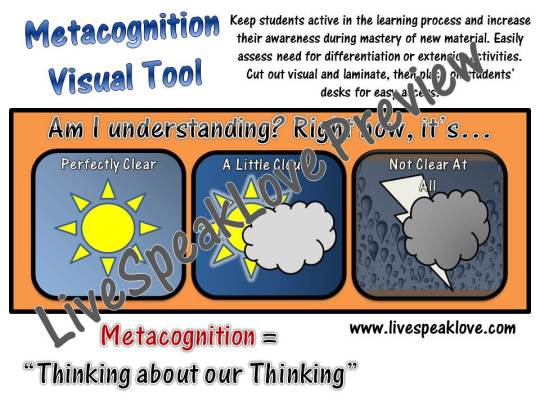
Next, you will definitely want this visual tool created to increase students’ metacognitive skills. What are metacognitive skills??? Essentially, “thinking about one’s own thinking.” It is an important skill to develop in students for academic reasons, but also so that they will be successful in LIFE. To be successful in any situation, it is important to be aware of what you KNOW and what you DON’T KNOW. Start developing this critical thinking skill NOW using this visual that can be applied to any subject area – reading for learning, reading for memory, reading for enjoyment, mental math, basic math functions, independent seatwork, collaborative groups, and the list goes on!!! Read more about metacognition at education.com (for starters — this is a big buzz word and there is a growing amount of research and instructional materials dedicated to this area of cognitive skill.)
Laminate this visual and place on each student’s desk, make copies to post at learning centers or in 100 Book Challenge or reading folders, blow up to poster size to use as a visual/anchor chart…and more! Increase student indpendence by encouraging learners to become part of the evaluation process.
I hope you are finding these materials useful. I would love your feedback about the types of resources you would like to see, your impressions of my current pricing (I am new and apparently have a bit to learn in this area) and any other feedback you would be willing to share. Feel free to leave a comment or email me at lisa@livespeaklove.com.
Halloween is one of my favorite times of year! Pumpkins, apple cider, costumes and crafts…there’s nothing like a little spooky fun to thrill students and engage them in their learning. Looking for ways to target a variety of academic and communication goals using a Halloween theme? Look no further! I have so many resources I’ve developed over the years that are tried and true winners. Check out my resources below, and follow the links over to my new TeachersPayTeachers site. Free downloads located at that site as well!
First, if you are looking for ways to target vocabulary, receptive and expressive language skills, turn-taking and visual discrimination, you will want to download my Halloween Bingo Set. Pair these colorful game boards with wh questions, verbal “mystery clue” descriptions, sentence formulation activities and more to target skills in a fun, creative way. Easily students’ activities to target IEP goals as you simultaneously work with a larger group — just vary the type of question or response that you are requesting as children take turns throughout the game. There a six different bingo boards in this set:
If you are looking for activities to target pragmatic language skills, try these Halloween Pragmatic Question Cards…definitely a hit with both students and other teachers! I always incorporate an activity like this into our pre-Halloween lessons and discussions — to target the social pragmatic skills that are often tested this busy time of year, but also to target Halloween safety. I have used this activity to do push-in lessons in the classroom setting, and all of the students in the class participate in very useful discussion generated by these questions. I have students draw the little cards out of a jack-o-lantern bucket, or hide them around the room for students to find while they get some opportunities for movement and kinesthetic learning in their day.
The next Halloween activity I have to share is Halloween Word World — an activity targeting /r/ in various positions of the word. This activity would also be great for students learning about /r/ controlled vowels, or for use as a simple seasonal activity. Have fun!
Activity for targeting /r/ in various positions
Here is a fun make-and-eat activity that my students (and graduate student interns) are STILL talking about, years later…making Spooky Spiders to eat! Target a variety of language skills including following directions, sequencing, sequential and ordinal vocabulary, basic math and literacy concepts and more. AND you get to eat these yummy little spiders!! I use the visual directions to also target comprehension and expression after the activity — summarizing the procedures, retelling the events in sequence using appropriate vocabulary, answering wh questions about the procedures…and then I send the recipe page home for students to make the spiders for their family…instant homework, generalization to the home setting, and very happy, proud little monsters.
You may be busy creating your own materials, resources or blog posts, and find yourself in need of some festive clipart. But if you are posting the clipart or distributing the images in any way, you need to make sure you are following the copyright laws. Not sure what to do? Not interested in paying the crazy retail prices for clipart packages or digital scrapbooking content? You may be interested in my latest endeavor — self-made clipart images. I won’t even go into the hours I spent makingthese in Powerpoint…creating each little critter line by line and shape by shape. I’m obviously not a digital image pro, but I think these images turned out pretty cute. And the images are designated for personal, educational and even commercial use. Please link back to my site if you do use these images in any way. I’m quite proud of my little creatures — labors of love, for sure!
I hope that you are now in the spooky Halloween spirit! You may have noticed that many (if not most) of my materials are seasonal or holiday-themed. There’s a method to my madness!! If there’s one thing I’ve learned over the past 20 years, it’s that children remember celebrations. Chilchood memories are often tied to holidays, vacations and school events. We are all wired to remember the extraordinary. So, why not make learning FUN and enjoyable? Even celebratory?? You can accomplish the same goals, cover the same material and reach the hearts and minds of children the same way — if not better- than with traditional classroom activities. Children remember celebrations…and they will likely remember YOU as well.
Wow, time really does fly when you are having fun– and when you are knee-deep in navigating a new position and new responsibilities! I am loving life as a new clinical faculty member at Towson University — teaching classes, supervising in the campus Speech-Language and Hearing Center and running a Pragmatic Language program for adults on the Autism spectrum. I wish I could list all of the things I’ve learned in the last few months! I’ve lost count. I feel blessed every day to go to work, and I love the variety my new position gives me. I feel this job is a noble and humble calling…training future speech-language pathologists through academic instruction and clinical experiences, also helping members of our community.
Beyond my new job, I do have a few updates for those who have been kind and patient with my recent blog neglect:
Team Living and Lovingdid it again! We supported a wonderful lady and raised over $2,300.00 with over 40 registered participants at the 2012 JT Walk to Stomp Out ALS! Here is a picture from our inspiring (albeit wet and windy) day:
Part of Team Living and Loving, lining up at the Start
LiveSpeakLove is now accepting appointments for consultations and assessments. Our ongoing therapy schedule is currently FULL; however, you may call and have your name added to our waiting list should a therapy time open up in the future. Feel free to call or email with any questions!
I now have a LiveSpeakLove store at TeachersPayTeachers.com! I am starting small and adding material as I go, but check out this site for more therapy and teaching materials, created by me! If you have used any of my materials in the past, you will not want to miss this opportunity for even more in-depth materials and supplies to target a variety of communication skills. Here you go! http://www.teacherspayteachers.com/Store/Lisa-Geary Don’t miss my FREE HALLOWEEN DOWNLOAD!!
Free Download!
I will be expanding my blog focus a bit to include topics and materials relating to my univeristy position. Coming soon: tools for mastering phonetic transcription, data collection and planning for therapy sessions. Also, topics in Autism across the lifespan, instructional technology in speech-language therapy and personal thoughts as I face the challenges of full-time work, an additional private practice, raising amazing children and more.
Product reviews are coming!! The months have flown past at an astonishing speed. In the back of my mind, have been several product reviews I still need to post. Of particular interest in the works–a review of a truly amazing book that I am currently using in my practice and at the university…Speaking of Apraxiaby Leslie Lindsay. More to come, but suffice it to say that this book is a gemand chock-full of everything any parent or professional needs to know about Apraxia.
I am sure there are more updates I’m forgetting, but at nearly 2:30 am, I will save them for another day. THANK YOU for your patience and for checking out LiveSpeakLove!!
I’ve recently discovered a new tech tool for speech-language therapy…Word Clouds. Using word clouds is a fun way to incorporate text into your speech-language lessons, perfect for increasing the speech-to-text connections. If you are utilizing Universal Design for Learning Standards (and you should be,) word clouds are also a powerful tool to customize the display of information, highlight critical features of a subject matter and incorporate media in learning activities. They are also just plain fun. Kids seem to really enjoy seeing their words and ideas instantly transformed into art.
Below are a few word cloud activities I have used recently. I’ve been exploring different features of the available word cloud sites, and I’ve included examples of my favorites:
Tagul.com – Below is a word cloud I made with a group using the Tagul Word Cloud Generator. Tagul allows you to customize the shape, colors and fonts, and quickly produce word clouds that can be saved as images, emailed or embedded into web pages. I used this word cloud site with a group of students as we generated categorical vocabulary given the topic “Things We See Outside in the Summer.” Students verbally produced categorical lists and then we reviewed the words, discussing similarities and differences between related word pairs.
ABCYa! – ABCYa! is a simple word cloud generator that is quick and user-friendly. There are limited layout, font and color scheme choices, but the word clouds are created instantly without fuss or worry over too many parameters. Below is a word cloud we created in a group co-treatment lesson with the social worker. As a follow-up to a story lesson, we generated positive attributes and descriptive words. We instantly created the word cloud, and the students then used the word cloud words to identify five attributes to describe themselves. We ended with a group discussion in which students offered positive attributes about their peers. The activity was engaging, powerful and memorable, as students used their speech-language skills to reinforce themes of self-concept, friendship and giving compliments.
Wordle – Wordle is another fun word cloud generator that allows custom colors, fonts and layouts (not in shapes, though) to produce a visual vocabulary display. With Wordle, you do need to capture screenshots of your word clouds in order to save them as images; otherwise they are stored online in a public gallery. Below is a brainstorm word cloud I created with a group as we identified relevant summer vocabulary words in response to the questions, “What do you like about summer?” Students eagerly participated in this group discussion, formulating sentences to describe their favorite summer pastimes and memorable events. A variety of language skills were targeted using this simple visual tool.
Tagxedo – Tagxedo is one of my favorite word cloud generators, allowing text to be displayed in a shape using customizable color themes and fonts. You can even have your word cloud in the shape of an actual word or phrase. I have been experimenting with the options that Tagxedo offers, and came up with this LiveSpeakLove Word Cloud:
There are many other word cloud generators available on the Internet. You can find a generous list of word cloud sites with a simple internet search. I would love to hear if you are using word cloud tools in your classroom and/or therapy rooms…feel free to post your ideas in the comments section. Thank you for visiting Live Speak Love, LLC!
I am once again very pleased and honored to be featured on ASHASphere, the American Speech-Language Hearing Association’s official online publication! Maggie McGary, ASHA’s Community and Socia Media Manager, wrote an article highlighting some resources available for spreading the word about Communication Disorders. The article features resources I posted on LiveSpeakLove, along with some other fabulous SLP ideas, tips and resources. Check them out and spread the word to “Connect People Through Communication!” Just click on the image below to view the article:
One of my personal goals this year is to increase the use of technology in my therapy sessions. Much of my “free” time can be spent compiling lists and exploring possible resources, applications, Universal Design for Learning strategies and interactive programs. I do plan on purchasing an iPad in the near future to use in my private practice, so I have been bookmarking lists of apps and other resources that the iPad offers. Though the school district for whom I also work has not yet authorized the use of iPads for instructional use, I feel quite fortunate to work in a setting that does offer a variety of additional technology resources — flipcams, smartboards, the ActivPanel I now have in my therapy room, and more. I have developed a few favorite tools that students really seem to enjoy, and the opportunities for engagement and interaction have increased immeasurably. I like to think I am pretty engaging all by myself, but there is something to be said about therapy that includes music, color, sound, movement, and electronic modes of presentation. Children today are wired for the technology (read more about this thought in my Signs of the Times post.)
One therapy tool that is quickly marching its way into first place is the use of video to target speech-language goals.For students whose performance is greatly enhanced with the use of music and visual stimuli, videos help to secure focused attention and engage their minds for interactive learning. I often insert a video into a smartboard lesson, designed to reinforce a theme or idea. Below is a video I found recently on Youtube, which I used in a caterpillar/butterfly seasonal theme. I used the video in a smartboard lesson that reviewed the lifecycle of the caterpillar/butterfly, and reinforced the recently presented story, The Very Hungry Caterpillar by Eric Carle. The video helped to help model use of descriptive concepts, and we used colorful scarves to incorporate motor movement and sensory input as we pretended to fly like the butterflies. Students were absolutely mesmerized by this tranquil video! They readily formulated their own phrases and sentences to describe colored butterfly pictures following the video:
I’ve also posted recently about using Animoto to create videos using music and selected images. I made another video today with a group of students to target expressive language, descriptive concepts, theme vocabulary and answering wh questions. To introduce summer theme vocabulary, I created a folder of Google images showing kids enjoying a variety of summer activities. Students took turns selecting the pictures they wanted to use in the video, and we practiced individual speech-language goals as we selected the pictures. Here is a visual I created to highlight the sequential directions for this video-making activity:
After we selected pictures, we uploaded them to Animoto, added the music track, and reviewed our objectives/progress while we waited for the video to finish “production” (a process that only takes a couple of minutes.) Then we were ready for step 4 — watching the video! I just loved seeing how connected and animated my students were when they saw the video and recalled the images they contributed. I noted increases in attention, participation, spontaneous verbalizations and use of targeted concepts in ALL students in the group. Here is the video that we made:
With so much success, I plan on using video as a therapy tool as much as possible — flipcam video and mobile device image uploads to star students themselves, interactive video clips in smartboard files, youtube videos that highlight concepts or themes, and other educational videos from sites like BrainPop, PBSKids, and more. I still reserve time and energy to create hands-on activities using games, toys, concrete objects and pictures; but the use of video as a therapy tool is clearly a winner in my book…er, umm– electronic reading device. 🙂
Wow, what an overwhelming response I received after being featured as a guest contributor on PediaStaff, sharing some of my Earth Day activities! I decided to share a few more ideas for those of you looking to plan your week with Green therapy, technology and activities that incorporate UDL strategies. Please feel free to click, download and share any of these resources. Enjoy!
Here is a lively video teaching kids to Reuse, Reduce Waste, Recycle. It will get everyone up, dancing and moving as they learn about the 3Rs of helping the world:
Are you looking for even more visuals/activities to address goals with Earth Day vocabulary? Here are a couple of creations for you — Free downloads!
Looking for some Earth Day Books to share with your students? Check out some of my favorite theme-based books that will reinforce the concepts you review in therapy sessions. Many of these books are available in e-reader and audio versions as well as print:
Also, I previously posted about a site that offers free online versions of books. For every book read, they make a donation to literacy campaigns around the world. What better way to help your students feel good about working to make the world a better place?? If you are not yet convinced, please watch this video that gives you an overview of the Pearson Foundation inititative. It is well worth a couple of minutes of your time:
So get reading! Use your computer, laptop or smartboard to create a multi-media, interactive story time that will also make you and your students feel good about helping others. Here are a few Earth Day selections (by the way, this post is not a solicited review of their site or program…I simply think it is a wonderful idea for many, many reasons!):
I hope you enjoy these ideas designed to offer engaging activities with multiple modes of presentation. The more I learn about what works in speech-language therapy, the more passionate I become about incorporating technology into my sessions. I would love to hear from those of you who are using similar technologies with your students. Thank you for visiting LiveSpeakLove!
I wanted to share a successful activity that I used with a group of students. We have been working on the formulation of sentences using correct verb forms. I posted previously about how to quickly extract Pinterest images from PediaStaff Pinboards to create activities for my interactive smartboard. We have all enjoyed the use of technology in our sessions, and students especially the sound files that are played as they interact with the images. Here is a snapshot of the activity I previously posted:
I have also posted previously about using Animoto to create multi-media videos using images I select. Students have really seemed to love the videos I have used so far. I decided to have a group of students help me create a video as part of their speech-language therapy, using images I extracted from the PediaStaff Action Verb Photo Library on Pinterest. To start, we reviewed the folder of images I extracted from the photo library, stored on the computer. Students took turns choosing which pictures they wanted to include in the video, and produced a sentence with their targeted verb form (e.g., “The lion is roaring.” or “The boy was crying because he was tired.”) As they took turns, I copied their selected images into a newly created folder to use for our Animoto video. After all the images were selected, we easily and quickly made our Animoto video. To make the video, we uploaded an mp3 file I bought for 99 cents from Amazon, and then we uploaded the images students just selected. We added a couple of text slides (as we reviewed the concept of Action Words, and the different verb forms each student was currently working on as their objective.) Ta-da!! Our video was created. After a couple of minutes to discuss each student’s progress, our video was ready to view. Students were amazed that the work they just completed was instantly transformed into their very own music video! This activity reinforced their work in such a dynamic, rewarding way. Students were excited, beaming and abuzz with chatter about how they had just made their own video — definitely a success!! I plan on using this technology tool again very soon. For your viewing pleasure, here is the video that my students created:
Interested in trying Animoto for yourself? Click here: Animoto
Spring is definitely in full swing! Our Spring Break is now over, but there is certainly no shortage of seasonal fun for the speech-language therapy room. I have been asked by Heidi Kay of PediaStaff to write a post highlighting activities that could be used for Earth Day. Heidi has pinned many of my activities on Pediastaff’s incredible collection of Pinterest Pinboards, and she also recently wrote an article for ASHASphere highlighting this Live Speak Love blog as one of the “Best Speech-Language Blogs A-Z.“ Wow! I am both honored and excited to present to you this Earth Daypost that is featured on the PediaStaff blog.
Earth Day, in my opinion, is a wonderful opportunity to educate children of all ability levels about the importance of taking care of our world. As children develop an understanding of the vocabulary, themes and issues, there are many teachable moments and life-changing conversations that can develop as a result. Earth Day is a universal cause, and it often sparks something in the minds of young learners. My own children have shown particular interest in the Earth Day theme, causing me to make changes in our family’s recycling habits. Children of all ages and ability levels can begin learning what it means to “Go Green” and care for the world in which we live.
These fun activities can be used to target almost any speech-language goal or objective. In the past, I have used Earth Day activities during individual and small group sessions, and also during co-treatment sessions with classroom teachers, the occupational therapist and/or the school social worker.
Here is a printable social story mini-book (four pages total to be cut into quadrants) you can use to introduce what it means to “Go Green.” Students will learn how they can conserve energy and protect the environment. You can even print an Earth Day Certificate for each student who pledges to do their part. Just click on the images to download:
Earth Day Bingo Boards are another great way to introduce the Earth Day theme and relevant vocabulary. During your Bingo Game, you can target myriad speech-language objectives like answering wh questions, formulating sentences using target vocabulary, labeling objects or using descriptive words in phrases and/or sentences. I often give “Mystery Clues” about a Bingo Picture, and students individually locate the target words from the given verbal descriptions. There are six different boards I made for you to download:
To teach about Recycling, I have used a few different sorting activities. These activities can be used to target word class, categorization, picture identification or labeling, answering simple wh questions, expressive language and more. Probably the most popular activity I have tried is actually taking a group of students outside for a “walk” where we discover an area littered with trash (pre-planted by me, of course.) After some discussion, students pick up the trash and decide what to do with it. Put it in the trash can? Recycle? Or (perfect critical thinking opportunity here) could it be saved to use again or perhaps re-purposed? This real-world, action-oriented activity really hits home with my students, causing many of them to search for trash (or treasures) on the school grounds or in their neighborhoods. Students love to come and tell me what they have found, and the action that they took. To do this activity with any sized-group, all you need is a pile of carefully selected “litter.”
If you do not have the opportunity to conduct this real-word exercise (or if you want to send a follow-up activity home for students to complete) I made this cut-and-paste version you could use:
For those of you with smartboards, you can use this virtual litter sorting game. Students will love dragging each item to its proper destination. If you have ActivInspire or a compatible program, just click on the link below to download the interactive flipchart I created:
Another great activity to use on a smartboard is this Going Green interactive game board. Just pair this game with any stimulus cards or questions that you wish to target. Students are always very enthusiastic about “rolling” the virtual dice and moving their game piece around the board. I have used similar game boards with both small and large groups. For larger groups, I place students on teams to increase interaction and decrease any wait time.
If you do not have a smartboard, or if you wish to insert the gameboard image to create your own file, here is a version you can import or print:
Working on those tricky /r/ sounds? Here are stimulus cards to target -er in all positions of words. Just print and cut to use with any open-ended activity (like the game boards above!) Or, print double copies to use in matching/memory games with the Earth Day theme:I’ve also used craft activities to incorporate fine motor skills, often in co-treatment sessions with the occupational therapist. Here is an activity in which students can follow sequential directions to create an “Earth.” Descriptive words, sequential and ordinal concepts, following directions and other language skills can be targeted in this “Go Green” project:
Whatever activities you choose, students will almost certainly appreciate learning how they can personally make a difference in our world. Doesn’t everyone want to feel that their actions have impact and meaning? So, Go Green this Earth Day, and enjoy teaching your students how to make our world a better place.
So many people have given me positive feedback about the Spring resources available for download in my Spring Egg-stravaganza post. One of the resources I posted was an open-ended game board — both a printable version and an ActivInspire flipchart version. For those of you who do not have ActivInspire, you can download it for free HERE. Check out this video for an overview of the kinds of things students can do with this program:
Obviously, if you have a smartboard, there are limitless possibilities for engaging students in multi-media therapy activities. I feel very fortunate to work in a school that had available funds and generous administrators. Earlier this year, my school purchased a desktop version of a smartboard for my therapy room. I have been using this technology to create a variety of lessons using pictures, audio, video and interactive design features that all my students love. Some of the files I create are complex, time-intensive and include pre/post assessment data collection where students respond using wireless ActiVotes. Some, however, like my Spring/Garden game board are really quite simple. To make this game I just imported the image of the game board (an image I actually used ActivInspire to create, but you could use any image — even a snapshot of a real game board,) then I added circle shapes to use as game pieces, and inserted the dice tool. Suddenly an ordinary game (with a dash of technology added) became a highly engaging therapy tool to target any objective needed. My students love the online game boards so much more than any “real” game. Here is a picture I previously posted of a couple of students interacting and playing a game using my desktop smartboard:
But what if you do not have a smartboard? Not to worry, you can still use these interactive files on your computer. You just need to use a mouse instead of the stylus (unless you have a touchscreen.) An adaptive mouse can help those with fine motor difficulties access this technology. You will just need to pair the game with stimulus materials or verbal prompts to elicit/train a skill, and your students will love playing the interactive, virtual game in their speech-language sessions.
If you want to download this file, just make sure you have ActivInspire installed on yourcomputer, then click on the image below.
By the way, I have no affiliation with Promethean or ActivInspire, and this post is not a solicited review. I really just love using this program, and I think you will too.
I was recently asked to offer some advice about correcting for those tricky sound errors — lisps and lateralized productions of the sibilants /s/, /z/, /sh/ and /ch/. If you are an SLP, you can probably detect a lisp or a lateralized /s/ on every affected public speaker, casual acquaintance or celebrity you have ever had the pleasure to encounter. My husband makes fun of me for the way my ears perk up and how the expression on my face clearly changes whenever we are listening to someone with an /s/ distortion. I suddenly have the urge to offer these speakers nonverbal feedback as we interact. Sadly, I can’t help it; it’s an affliction. Even if you are not an SLP and have no desire to cure the world of lateralized airflow patterns, you may be able to detect that something is not quite right in the way a person says their /s/ and /z/ sounds— the words come out sounding “slushy,” “sloppy” or even “garbled.” I once had a teacher tell me that their student with a lateralized /s/ sounded like he was “pretending to be a ventriloquist.” This statement was actually not an off-target description.
Lateralized airflow sound distortions are unfortunately some of the hardest to correct. While I am an SLP, and therefore, an “expert,” I do not profess to have any secret knowledge or special talent in correcting these tricky sounds. I have struggled along with the rest of you in finding ways to train for correct sound production. I am happy, however, to share what has worked for me more often than not in the past fifteen years.
In my opinion, the issue of lateralized airflow distortions is two-fold, and requires training on both factors:
Students do not have a correct tongue position for these sounds (and often the tongue position at rest is incorrect as well.) These sounds must be produced with the tongue elevated to meet at the alveolar ridge or surrounding area.
Students do not have a correct frontal airflow stream (probably secondary to incorrect tongue position) . When the tongue is elevated at the alveolar ridge area, a slight groove is formed in which airflow is then directed in a stream out the front of the mouth. When the tongue remains low and flat, no slight groove in the center of the tongue is formed to direct the airflow out the front. The air escapes out the sides of the tongue and the distortion is produced.
Unfortunately, the tongue and airflow patterns are habitual and must be entirely retrained for correct sound production. Therapy on these sounds begins with ongoing student education for tongue position and airflow. I often begin with pure discussion and education using mouth diagrams, puppets, mirrors, and visuals. I then begin training with some oral motor tools or tricks like dots of icing on the alveolar ridge or other tactile feedback to elicit correct tongue placement. I have students practice in front of mirrors and watch me as well. My school recently purchased these mirrors for my therapy room so that each student has their own for practice (great for preventing “downtime” while I give individualized feedback to other students in the group):
Once the initial training and tactile feedback has been provided, I quickly move into practicing target sounds in isolation and then in syllables or words. I use a variety of methods including verbal, visual and tactile strategies to help students train for correct placement and airflow. I have visuals for each target sound that offer descriptions so students can more easily remember the placement and manner of the sounds. I usually start by targeting /s/ in isolation, though I do not believe that this sound is scientifically proven easier to produce than any of the others. I just personally find it easiest to elicit, especially when introduced as “the sneaky snake sound” and paired with different snake games/activities. Every therapy session I conduct is structured to include education, discrimination, direct training, and then practice (often using games or other motivating activities) to target sounds in isolation, syllables and words. These activities all include the following visuals (or similar.)
Below is a visual that introduces each sound and gives them all a “name” to represent sound attributes in some way. At the bottom of this visual is a three-step process chart that helps to elicit correct placement and airflow. I have had very good success using the cue “Teeth Together.” This cue is something much more concrete and outwardly visible than the more elusive “tongue elevation to the ‘bumpy spot’ behind the teeth.” For some reason, tongue placement seems to greatly improve and inhibit lateral airflow when the upper and lower central incisors meet in front (not in a smile, though, which tends to drop the tongue and foster lateral airflow. Think “show your teeth” in a Lady Gaga kind of way.) Students can see their teeth together; they can replicate it easily, and for whatever reason, it often works when it is done correctly. Students are also trained to hold their hand or finger in front of their lips and feel the airflow as they speak. Sometimes this trick is enough to elicit the frontal airflow pattern and progress is made quickly as the student has built-in cues and biofeedback wherever they go!
Another visual I like to use is this discrimination tool that can be used both with the student listening to modeled productions or when producing on their own. The clinician can provide the feedback using the visual, or the student can self-evaluate their own productions:
Students are encouraged to practice their sounds on their own using their hand as a self-cueing strategy for frontal airflow detection:
As we move into practice using syllables and words, I select the syllable or word targets to specifically shape and elicit correct tongue placement. I choose syllables and words using vowels that are produced higher in the mouth (usually /i/ and /u/) to move away from the low, flat tongue patterns used in /a/ or with a schwa. I also vary the position of the sound in the word or syllable:
Another way I elicit correct tongue position is to shape sounds across word boundaries using alveolar sounds that the student has already mastered. Here is a visual I use with students to shape the /s/ from /n/ across preceding and subsequent word boundaries:
As a student becomes more independent, the same pictures can be used to create sentences for practice at a higher level. My go-to games are often open-ended game boards, commercial games or interactive activities that can be paired with specific stimuli or picture cards using the currently targeted sound or sounds. I also use barrier games or student-led activities with a focus on peer feedback to encourage generalization to other settings. I often have peer partners that will develop their own nonverbal signal to prompt for correct placement or airflow.
Above all, a student needs to “buy in” to the training and practice their skills in other settings. This is why all of my speech therapy sessions incorporate the pieces of education, discrimination, targeted training and practice. If students are reluctant to practice or do not self-cue or self-monitor, then progress will likely be much slower. Systematic training in tongue placement, frontal airflow stream, how to self-cue and monitor, and how to practice are essential components of a treatment program for lateralized airflow sounds. The treatment program may seem endless some days as you train and educate, but eventually, most students “get it.” I consider my work with these students just as important as my work with nonverbal or language-delayed students and I applaud those of you who work tirelessly to improve communication skills on any level. Good luck with using these techniques, and I’d love to hear if there is something else that has worked for you. Please share — it’s exactly what I love about the internet!





 to share with your students? Check out some of my favorite theme-based books that will reinforce the concepts you review in therapy sessions. Many of these books are available in e-reader and audio versions as well as print:


